Good intentions don't survive Monday because nothing supports them. A change sticks when it has one owner, one number and a standing slot on a weekly agenda. Accountability!
Have you ever left an offsite fired up? New priorities, real clarity, the whole leadership team nodding at the same slide.
By Wednesday you were back in your inbox, and the plan had quietly become a document nobody opens. That is not a discipline problem. It is a design problem. It's. Not. Your. Fault. You just didn't have the right tools. Before EOS, none of us did!
Back to Basics: willpower is a terrible operating system
Wooden never relied on his players wanting to run the play. He built the drill so it happened whether anyone felt like it that day or not. The intention was never the thing holding it up. The structure was. (I could use this reminder for my workouts!)
Good intentions are real. They are just the least durable material you can build with. Monday is where they go to die, because Monday has a busy calendar and your intention has nothing to support it.
When we were building our remodel company
Before EOS, we came back from planning sessions with pages of what we were going to do differently. After we adopted EOS, the goals that survived had three things the others didn't: a name attached, a number to watch, and a standing slot on a weekly agenda.
A priority is not a priority until it has a home
Here is the test. For the change you care most about right now, can you answer all three?
Who owns it. Not "the leadership team". One person.
What number tells you it is working. Not your "gut", but a number.
Where does it get looked at every week. A real recurring slot, on a real agenda.
If any of the three is blank, the change is still running on willpower, and Monday may win.
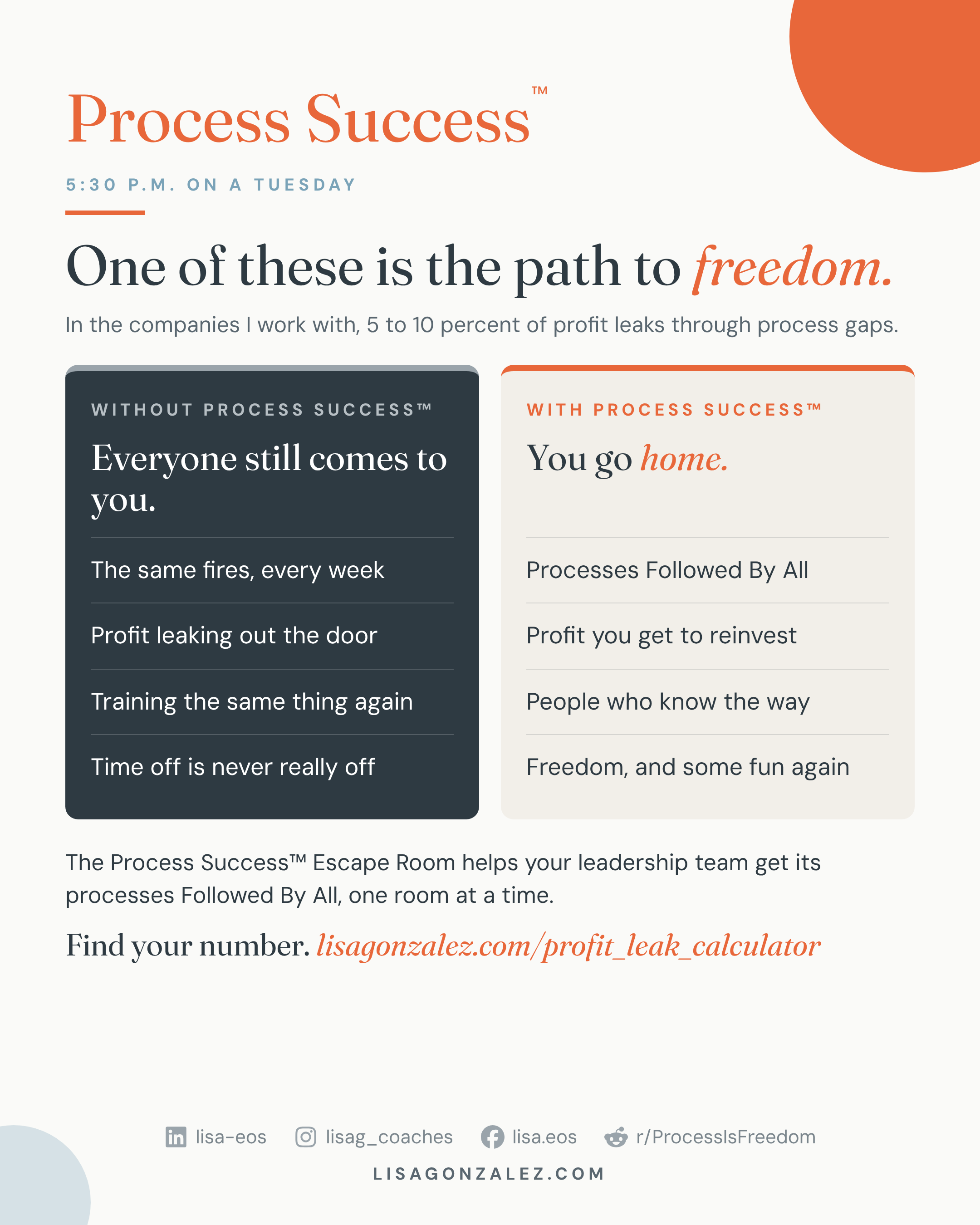
The picture
This is what it looks like when the structure carries the work instead of the person. I invite you to save it, print it, put it where the team will see it.
The AI prompt
Paste this into the AI tool your company uses. Check your company's AI policy first, keep anything sensitive out of it, and read what comes back with discernment.
Act as an operations advisor. I'll describe one change my leadership team agreed to that hasn't actually happened. Ask me one question at a time to find where it lost its structure: who owns it, what number would show it working, and which recurring meeting it belongs on.
Then help me write the owner, the measure and the meeting slot in one sentence I could read out loud at our next weekly meeting.
Love that last sentence. One sentence, read out loud, with a name in it. That is usually the whole fix.
Process creates freedom, and freedom runs on structure.
Pick the change that keeps sliding. Give it an owner, a number and a slot before Monday.
Lisa
Save the date
- For EOS Implementers: Monday, February 8. The EOS Implementer® Process Workshop. Free, 90 minutes, live on Zoom. Walk into your next Quarterly more confident to teach Process. Live only, so there is no replay. Save your seat at lisagonzalez.com/pages/february-8-implementer-process-workshop.
- For companies running on EOS: Monday, March 8. The Process Component Bootcamp. Free, 90 minutes, 11:30 AM to 1:00 PM Mountain, live on Zoom. An introduction to self-implemented process work and the simple tools to start it. Bring your leadership team. It is not recorded, so there is no replay. Register at lisagonzalez.com/process-success-bootcamp.
Both are sponsored by Strety.
P.S. If your leadership team would rather do this work in one day, together, with me in the room, reply to this email and I'll send the details.
Reading a forward? Subscribe at lisagonzalez.com. Every two weeks: one real problem, one AI prompt, one practical move.