I grew up assuming everyone must work with their spouse.
My parents ran businesses. We all pitched in. That was just a regular Tuesday. So when I grew up, got married, left my law firm practice and started working alongside my husband in our remodel company -- it didn't strike me as a decision. It struck me as the natural order of the universe.
It took me an embarrassingly long time to realize that working with your spouse is, in fact, optional. People choose it. On purpose.
Some couples go their entire marriages without once debating subcontractor schedules over dinner. I had never considered the alternative.
Back to Basics: Why family and business get tangled
There's a reason mixing family and business feels uniquely tricky, and it isn't that your family is uniquely complicated.
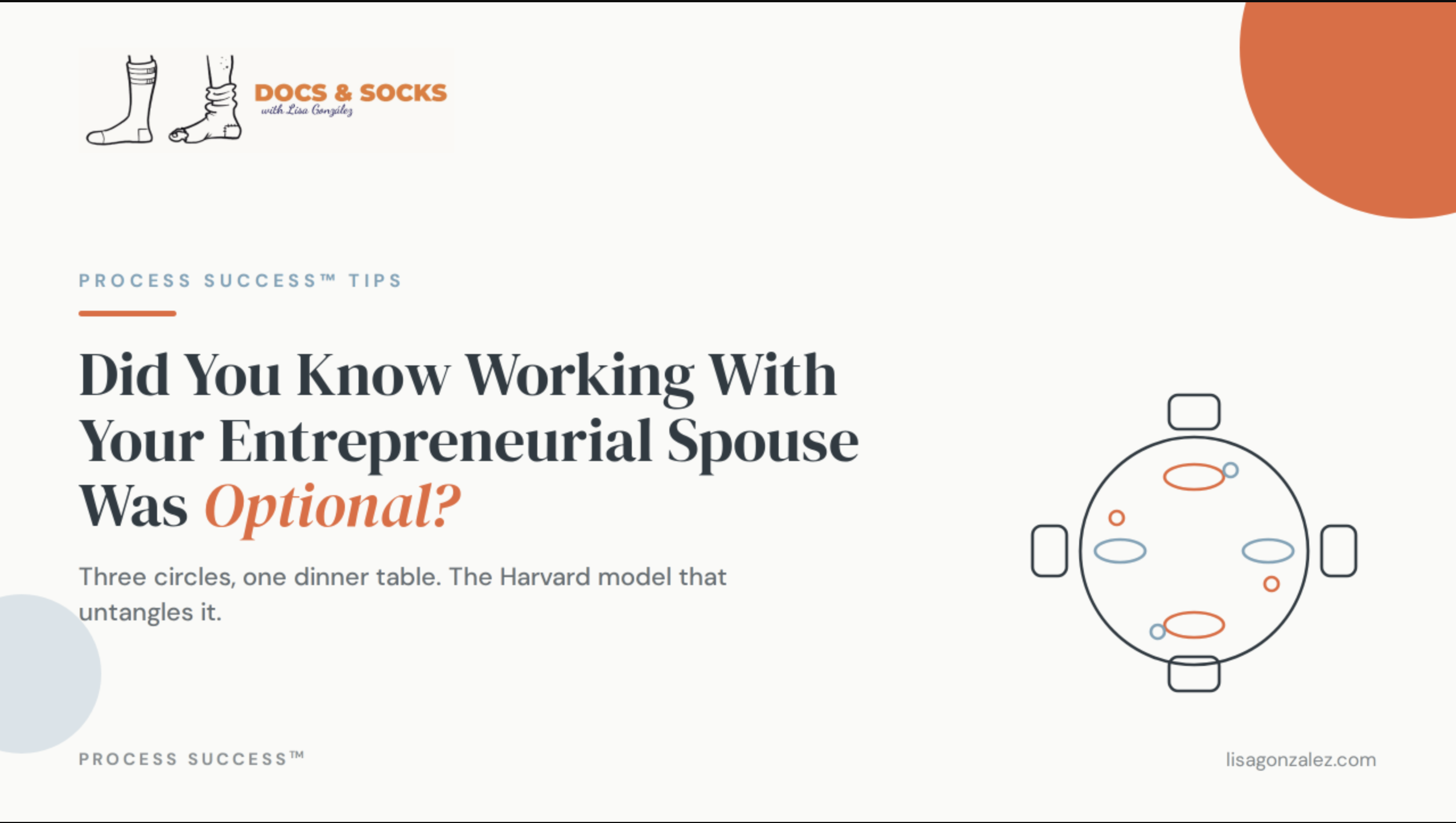
In 1978, two researchers at Harvard Business School, Renato Tagiuri and John Davis, sketched a model to explain it. Three overlapping circles: Family, Business, and Ownership. Everyone connected to a family business sits somewhere in those overlaps. It's still the dominant framework for understanding family businesses worldwide, more than forty years later.
Here's why it matters. The tension you feel isn't a character flaw. It's a circles thing. The same conversation can mean three different things depending on which circle you're standing in.
When my husband and I spoke about our business, we might have be talking as spouses (Family), as the people who run the work (Business), or as the people who carry the risk (Ownership). Three circles, one dinner table. When nobody names which circle they're in, you have three conversations at once and wonder why it got complicated over arroz con salchicha.
The Dinner Table Test
I have a deeply scientific metric for how our family business is doing.
It's the dinner table.
You can measure the balance of a family business by the joy or the tension at dinner. Light and easy? The circles are probably sorted. Quiet in a particular way, or one of you keeps “just circling back” to the schedule between bites? Two people are standing in different circles and haven't said so out loud. Completely silent. Time for a same page meeting!
The tension at the table is rarely about the actual decision. It's about two people in different circles. One of you wants a calm evening. One of you wants the business to thrive. Both are right. You're just standing in different circles.
The Unglamorous Fundamental
Wooden taught his players to smooth the wrinkle before it became a blister. Here's the family-business version.
Name the circle before you start the conversation.
“Can we talk about this as a couple, not as business partners?” Or, “Put your owner hat on for a second.” It sounds almost too simple. It's also the single most useful sentence I know for couples and families who work together. It won't make the hard calls easy. It makes them clear. And clear arguments are a lot shorter than tangled ones.
A Prompt to Map your Own Circles
If you work with family, or you're married to your business, try this. Paste it into the AI of your choice, and use your own judgment, because this one can get personal.
Process Success: AI Prompt
"Assume the role of a family business advisor familiar with the Tagiuri and Davis Three-Circle Model (Family, Business, Ownership). I work in a business alongside [spouse, parent, sibling, etc.].
Ask me one question at a time to help me map when our family, business, and ownership roles overlap and create the most friction for us. Keep it practical and plain."
When you have enough, identify the two or three conversations you're probably having “in the wrong circle,” and suggest one sentence I could use to name the circle before each one. If you're ever in pajamas when discussing business, it's probably a good sign that you're in the wrong circle.
A quick and important note: this is a starting point, not therapy, and the model is a thinking tool, not professional advice. Keep what's private private. If something deeper is going on, a good counselor beats any framework. The circles just help you see the shape of the thing.
The Worksheet
If you'd rather work it by hand, I built a one-page worksheet that walks the same three steps. It goes out free to every Docs & Socks subscriber. You can access it here.
Remember - if you're building the business with the person you married, you didn't sign up for harder. You signed up for closer.
Process creates freedom, at the office and at the dinner table.
Correct the circle this week. Just once, before one conversation. Then go enjoy dinner.
Next Steps
If you found value in this content, please forward this to one leader who’s still the operating system of their business and hopefully it can help them out as well.
They can subscribe to Docs & Socks here.
When a template isn't enough, we can help. Visit lisagonzalez.com for more free tools, or to explore workshops for you and your team.
Talk soon!
Lisa